
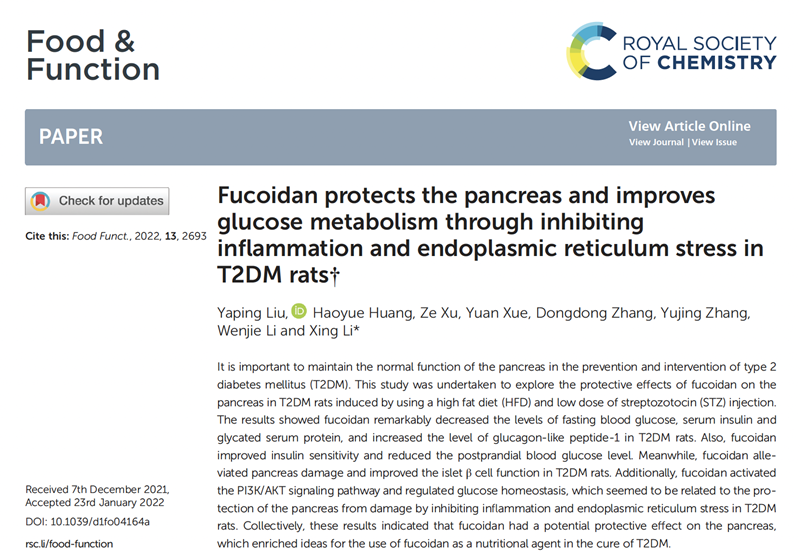
Fucoidan protects the pancreas and improves glucose metabolism
Diabetes, a chronic disease known as the "sweet killer," affects hundreds of millions of people worldwide. Type 2 diabetes (T2DM) accounts for over 90% of all diabetes cases. Recently, a study published in *Food & Function* found that fucoidan, extracted from brown algae, may offer new hope in the fight against diabetes by protecting the pancreas and improving glucose metabolism. Let's explore how this research reveals the amazing effects of this marine molecule!
Diabetes: The Pancreas's "Invisible Attacker"
The core issues of type 2 diabetes are insufficient insulin secretion and insulin resistance. Long-term high blood sugar acts like a "sugar-coated bullet," attacking pancreatic beta cells and causing functional impairment or even death. Even more alarming, high blood sugar can trigger inflammation and endoplasmic reticulum stress (ERS), further exacerbating pancreatic damage.
Research Design: Scientific Verification of the Efficacy of Fucoidan
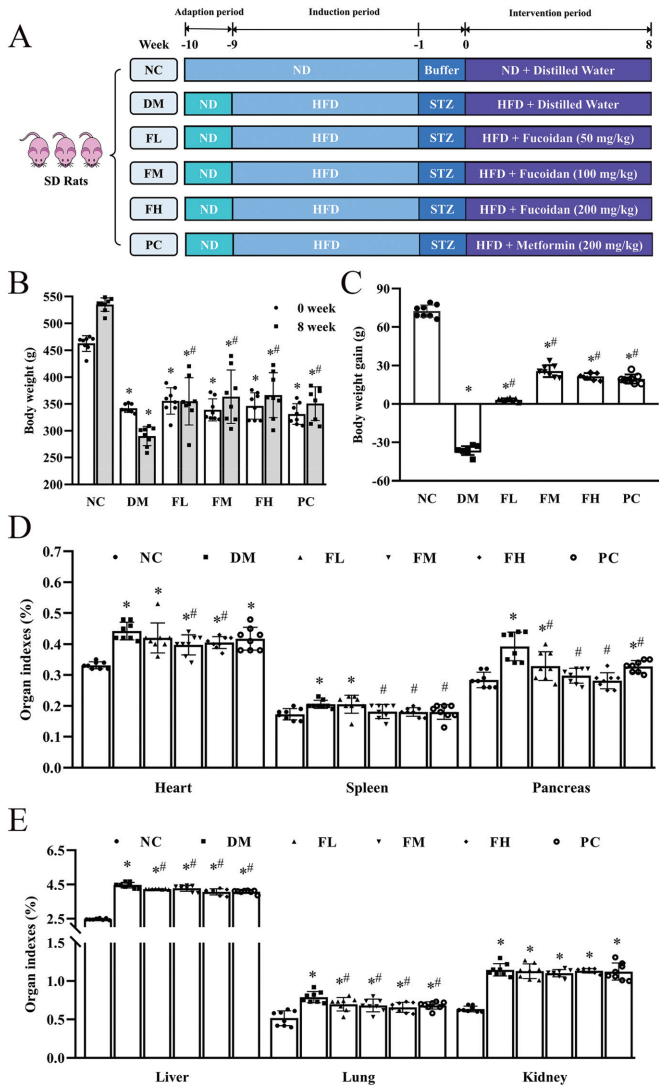
Researchers successfully established a rat model of type 2 diabetes mellitus (T2DM) by combining a high-fat diet with low-dose streptozotocin (STZ), mimicking the pathogenesis of human type 2 diabetes. The experiment included multiple groups: a normal control group, a diabetic model group, low-, medium-, and high-dose fucoidan groups (50, 100, and 200 mg/kg), and a positive control group (metformin). The intervention period was 8 weeks.
Blood Glucose Control: Fucoidan Shows Impressive Results.
Research results show that fucoidan significantly reduces fasting blood glucose levels. After 8 weeks of intervention, blood glucose levels decreased by 13.30%, 13.98%, 18.17%, and 20.00% in the different dosage groups, respectively. Simultaneously, fucoidan also improved glycated serum protein (GSP) levels and increased glucagon-like peptide-1 (GLP-1) secretion. In the oral glucose tolerance test (OGTT), the blood glucose levels of rats in the fucoidan treatment group peaked at 30 minutes and then rapidly decreased, while the blood glucose levels in the model group remained at a higher level, indicating that fucoidan can significantly improve the body's glucose tolerance.
Pancreatic Protection: Comprehensive Improvement from Structure to Function
Even more surprisingly, fucoidan showed a significant protective effect on the pancreas. Histological examination revealed that the islets of Langerhans in the diabetic model group exhibited compensatory hypertrophy, irregular morphology, and extensive lymphocyte infiltration. In contrast, the islet structure in the fucoidan-treated group was significantly improved, with more regular cell arrangement and a marked reduction in inflammatory infiltration.
Immunofluorescence staining results showed that fucoidan significantly increased insulin secretion, reduced glucagon levels, and restored insulin/glucagon balance, indicating that fucoidan can effectively improve β-cell function.
Mechanism of action: Intelligent regulation through a two-pronged approach
This study delves into the mechanisms of action of fucoidan:
1.Inhibition of inflammatory response: Fucoidan significantly reduces the mRNA and protein expression levels of key inflammatory factors such as TLR4, MyD88, IKK, and NF-κB, alleviating pancreatic tissue inflammation by inhibiting the TLR4/NF-κB signaling pathway.
2.Relief of endoplasmic reticulum stress: Fucoidan downregulates the expression of endoplasmic reticulum stress-related markers such as GRP78, IRE1, CHOP, and JNK, while regulating the Bax/Bcl-2 balance and inhibiting β-cell apoptosis.
3.Activation of insulin signaling pathway: Fucoidan promotes the phosphorylation of IRS1, PI3K, and AKT, upregulates GLUT2 expression, and downregulates FOXO1, thereby activating the PI3K/AKT signaling pathway and improving insulin signal transduction.
This study not only confirmed the hypoglycemic effect of fucoidan but also revealed its multiple advantages:
Natural and safe: Derived from edible brown algae, it has high safety for long-term use. Multi-target action: Simultaneously regulates multiple aspects of inflammation, stress, and signaling pathways.
Protective therapy: Not only lowers blood sugar but also focuses on pancreatic protection.
Dose-dependent: The effect is more significant at medium to high doses, with a clear dose-response relationship.
Currently, fucoidan, as a dietary supplement, has shown promising application prospects. This study provides solid scientific evidence for its application in the adjunctive treatment of diabetes. In the future, fucoidan is expected to become a new option for comprehensive diabetes management, especially for diabetic patients who require long-term medication, where its natural and multi-effect characteristics offer greater advantages.
This study opens up a new perspective: protecting pancreatic function is equally important while controlling blood sugar. As a natural marine product, fucoidan's multi-target and protective effects provide new ideas for diabetes treatment. Although more clinical research is needed to verify its effectiveness, this discovery undoubtedly brings new hope to diabetic patients. Controlling blood sugar starts with protecting the pancreas!